

Climate scientists and environmental groups lead consumer trust on climate information by a wide margin. Corporations rank near the bottom, just above politicians.
When brands make climate or sustainability claims, they are entering a conversation that already has a clear trust ranking among consumers. Understanding where corporations sit in that ranking, and what that means for how brands communicate, are actionable insights the data offers.
Consumer trust in different sources for climate information varies widely. Climate scientists (76%) and environmental and conservation groups (75%) lead by a substantial margin. News media (58%), energy industry leaders (56%), and social media (50%) follow in the middle. Large businesses and corporations (45%) and elected officials and politicians (42%) trail at the bottom.
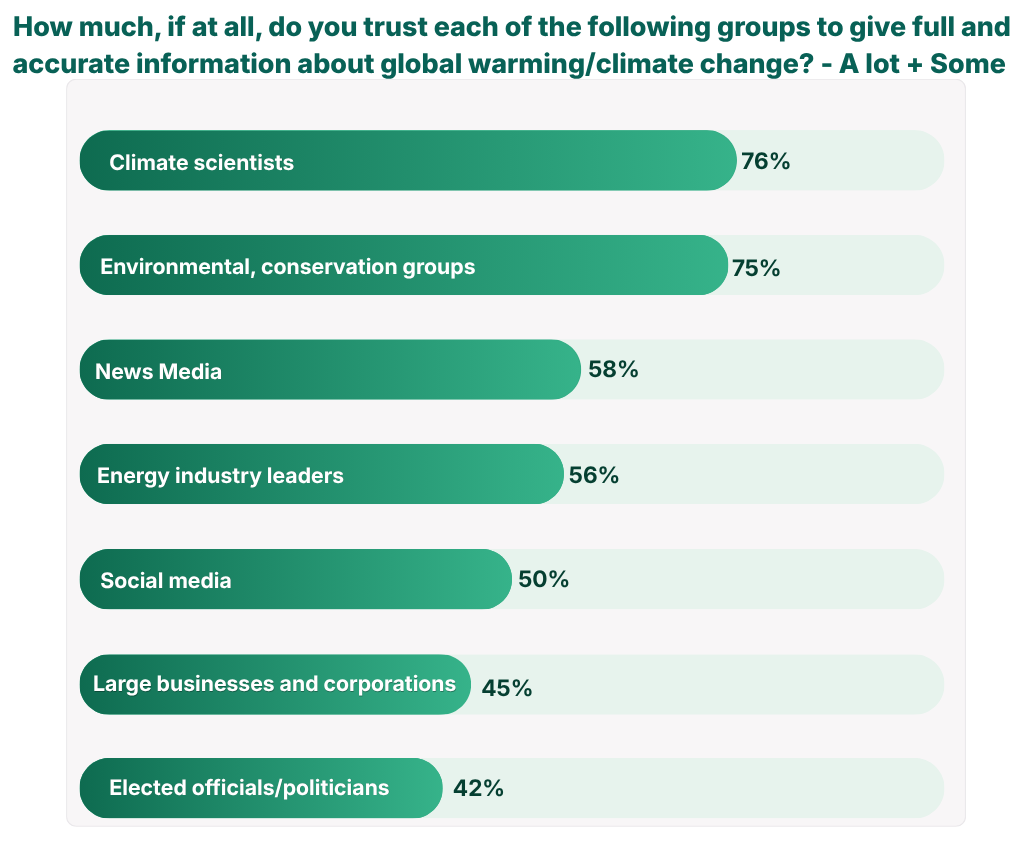
The difference between climate scientists and corporations is 30 percentage points. That is a fundamental credibility gap that shapes how consumers receive climate information from brands before a single claim is made.
Corporations ranking near the bottom doesn't mean consumers dismiss corporate sustainability efforts entirely. It means they approach corporate climate claims with a higher bar for proof than they apply to scientists or environmental groups. The burden of proof is higher than most brands may account for in their sustainability communication, and broad claims made on corporate authority alone are the least likely to move a skeptical audience.
The data shows where credibility lacks. Addressing this requires deliberate choices about how brands communicate. Three approaches are worth considering. First, increase credibility by partnering with trusted sources. Third party certifications, scientific backing, and collaborations with environmental organizations carry more weight with consumers than the same commitment stated by the brand alone. Second, lead with transparency and proof. Brands that present specific, verifiable information are better positioned than those making broad environmental claims consumers have no way to evaluate. Third, recognize that corporate voice alone is the weakest starting point in this trust ranking. Showing specific numbers, verified outcomes, and named partners is more persuasive than asserting values.
The trust gap is not a reason for brands to stay silent on climate and sustainability. It is a reason to be more deliberate about how they speak. Consumers are not opposed to hearing from corporations on these topics. They are applying a higher standard of proof than they apply to scientists and environmental groups. Brands that meet that standard will stand out from those that don't.
What's the Takeaway?
Corporations rank near the bottom of consumer trust for climate information, just above politicians. The low trust consumers place in corporations on climate is not insurmountable, but it means brands cannot lead with their brand reputation on climate and expect to be believed. Increase credibility by partnering with trusted sources, present specific and verified data, and show your work rather than assert your values.