

Eight in ten Americans are concerned about AI's energy consumption contributing to climate change.
Climate Week NYC 2026 concluded last week after bringing more than 100,000 people together across more than 1,000 events in New York under this year's theme, “Energy. Impact. Action.” Among the issues addressed throughout the week, the environmental impact of artificial intelligence emerged as an important part of the conversation. As MIT Technology Review reported, “there's been a growing tension bubbling up about AI's impact on climate and climate tech.”
That tension reflects a fundamental question about AI's rapid expansion: can its potential benefits justify its growing environmental costs? According to the same MIT Technology Review, Microsoft, Google, and Meta have each set ambitious emissions-reduction goals, yet their emissions have risen as they expand the data center infrastructure needed to support AI. At the same time, the companies are investing heavily in clean energy to support that growth. The question of whether AI can help address climate challenges without adding to them was a recurring theme during Climate Week.
As UN Secretary-General António Guterres put it in his opening remarks, “Artificial intelligence could help solve all these challenges, or it could make them worse.”
The consumer perspective adds another dimension to this debate. EcoFocus research shows that Americans are paying attention to AI's environmental footprint—and expressing concern about its potential consequences.
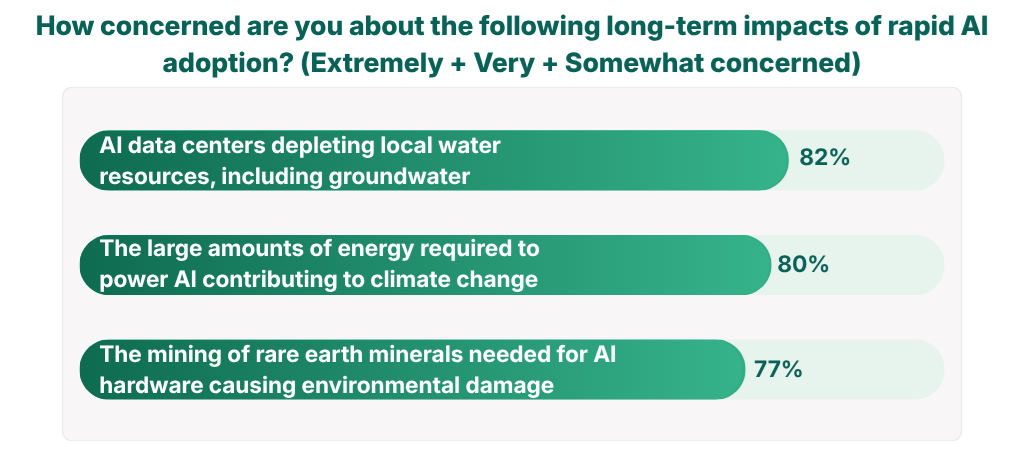
That concern extends across energy, water, and materials. Eighty percent of Americans are concerned about the large amounts of energy required to power AI contributing to climate change. Eighty-two percent are concerned about AI data centers depleting local water resources, and 77% are concerned about the mining of rare earth minerals needed for AI hardware causing environmental damage.
At the same time, Americans are less likely to view AI as central to addressing climate change. Only 38% agree that “AI is key to finding solutions to climate change,” while 28% disagree. The results suggest that although consumers recognize AI's potential, relatively few currently see it as a key part of the solution to climate change.
That perspective is consistent with the broader debate at Climate Week. UN Climate Change Executive Secretary Simon Stiell warned that “AI leaders are now on thin ice when it comes to license to operate and sinking deep underwater when it comes to public support,” adding that “Tech titans need to start showing why the benefits of AI outweigh its skyrocketing costs—for the many, not just the tiny few.”
Consumers are concerned about AI's environmental impact, but they are not walking away from it.
Yet concern is not translating into widespread avoidance of AI in products, apps or services. Only 35% of Americans say high energy and water consumption would make them less likely to purchase or use a product with AI features. The result is a consumer landscape characterized by concern without rejection: Americans are continuing to engage with AI while questioning how responsibly its environmental consequences are being managed.
This gap between concern and behavior is an important part of the AI and climate conversation. Individual consumers cannot address the energy and water demands of AI through purchasing decisions alone. The scale of the challenge involves data center design, grid capacity, emissions, energy sourcing, and the materials required to produce AI hardware. Addressing these issues will require action across technology companies, energy providers, and policymakers—the same broader systems-level questions being examined at Climate Week.
For brands integrating AI into their products and operations, the consumer message is taking shape. Americans are paying attention to AI's environmental footprint and expressing concern about its impacts across energy, water, and materials, while relatively few see AI as key to solving climate change. Yet those concerns do not appear to translate into a strong stated reluctance to purchase or use AI-enabled products. As AI becomes more embedded in everyday products and services, understanding this tension will be increasingly important.
What's the Takeaway?
Consumers are not ignoring the environmental implications of AI, even as those concerns may not be a strong deterrent to purchasing or using AI-enabled products. For brands, transparency around AI's environmental impact and the steps being taken to reduce it can help build trust as consumers become more aware of the technology's environmental footprint.