
.png)

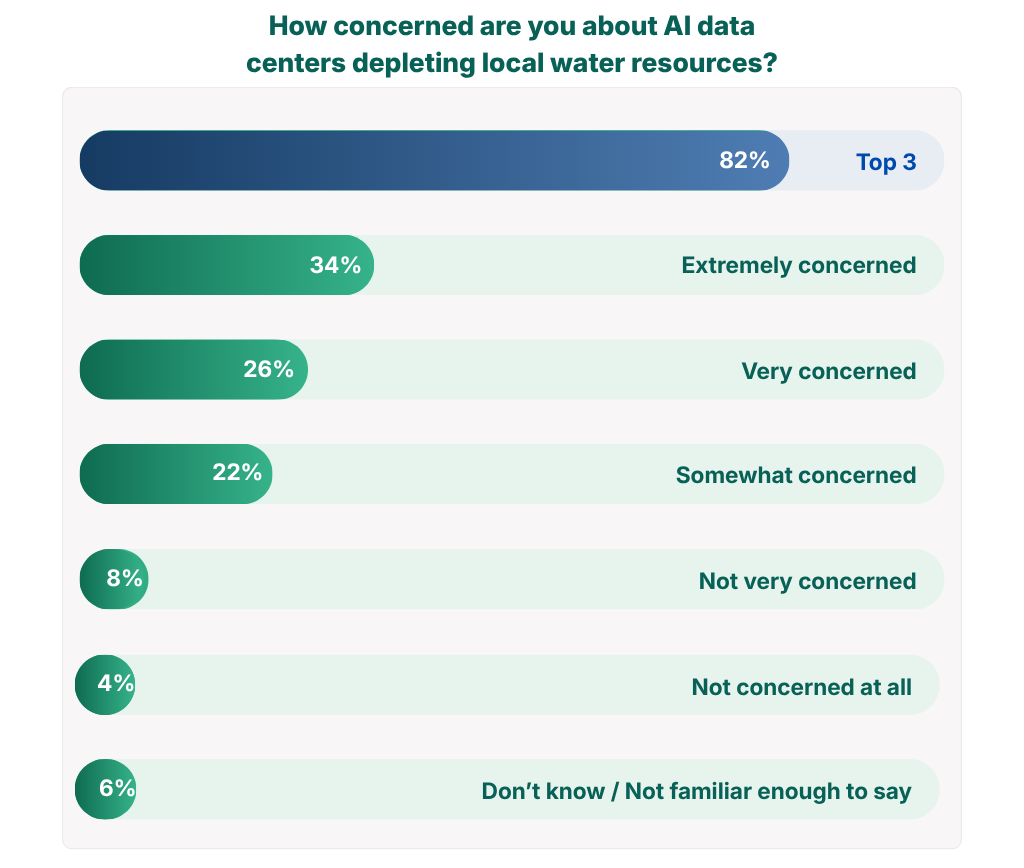
Eight in ten consumers are concerned about AI data centers depleting local water resources.
World Water Week draws global attention to one of the planet's most pressured resources. This year it coincides with a moment when AI adoption is accelerating across industries — and the connection between the two is less obvious than it should be. AI data centers require substantial amounts of water for cooling, and that consumption is already registering as a mainstream consumer concern.
Eighty-two percent of consumers are concerned about AI data centers depleting local water resources, including groundwater — one of the highest concern levels across our AI data. Thirty-four percent are extremely concerned and a further 26% are very concerned.
Thirty-five percent of consumers say AI's energy and water consumption would make them less likely to purchase AI-powered products.
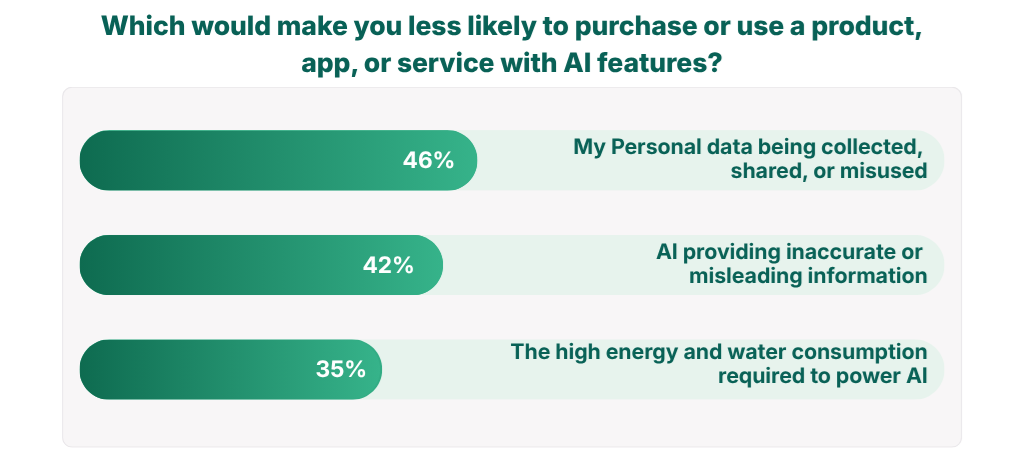
Beyond concern, the data shows a behavioral dimension, i.e. how consumers shop. Thirty-five percent of consumers say the high energy and water consumption required to power AI would make them less likely to purchase or use a product, app, or service with AI features. That purchase hesitation is not their dominant AI concern — data privacy and accuracy rank higher — but it is significant enough to warrant attention from brands whose products or services incorporate AI.
AI adoption is now a mainstream business choice that carries an environmental footprint most brands haven't fully accounted for in their sustainability thinking. Water consumption is a specific and growing dimension of that footprint. Brands that get ahead of it — understanding their AI-related water exposure, choosing water and energy efficient AI solutions where possible, and communicating transparently about the tradeoffs — are better positioned than those that haven't considered it.
For brands that have made explicit water stewardship commitments, the stakes are higher. The gap between a stated water commitment and unaddressed AI water consumption is specific and measurable — and the consumers who care enough about water to notice a brand's commitment are likely the same consumers who will notice the contradiction.
Water stewardship and AI adoption are not inherently incompatible, but they require deliberate alignment. As AI becomes a standard business tool, its resource footprint will become more visible and more scrutinized. Brands that acknowledge it now are ahead of a conversation that is only going to grow.
What's the Takeaway?
AI has a water footprint, and consumers are concerned about it. Every brand adopting AI should understand its water exposure and factor that into its sustainability story. Where AI adoption increases water consumption, expanding water stewardship commitments — watershed restoration, water recycling, community water initiatives — is a concrete and credible response.