


Brands have many ways to talk about their environmental commitments. To understand how consumers respond to different messaging, we tested pairs of statements representing different approaches. The results point to meaningful differences that are worth considering when planning sustainability communication.
Specific and measurable claims, values language, and credentials each resonate differently with consumers.
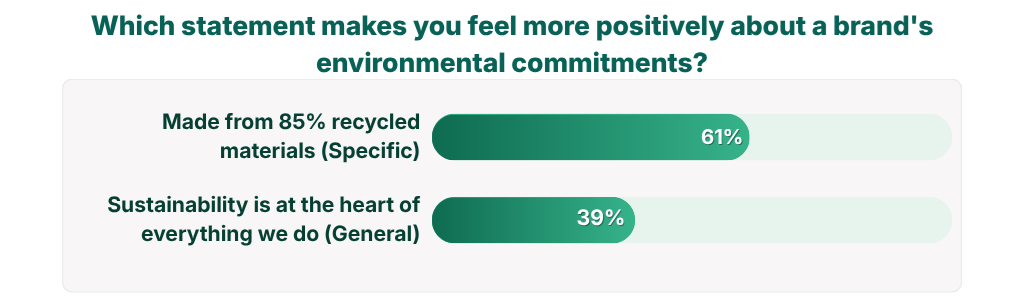
When consumers chose between a specific measurable claim and a broad values statement, the specific claim performed more strongly. 'Made from 85% recycled materials' resonated with 61% of consumers, while 'sustainability is at the heart of everything we do' resonated with 39% .
When the choice was between values language and a credential, values language performed more strongly. 'Environmental stewardship is at the core of our values' resonated with 66% of consumers, while 'Certified B-Corporation since 2019' resonated with 34%.
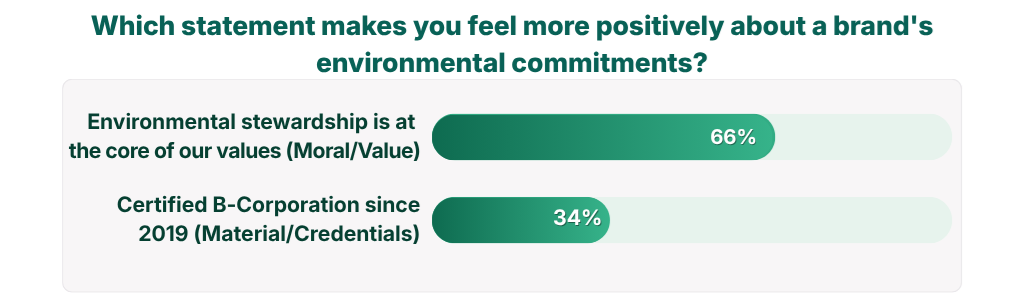
In our test, credentials on their own resonated with fewer consumers than values language.
Taken together, these two tests suggest a pattern. Specific and measurable claims performed more strongly than values language, and values language performed more strongly than credentials alone. While these results reflect the specific statements tested, it is worth noting that these findings are a starting framework for planning: specific and verifiable claims are a foundation for sustainability communication. Identifying the right values language can create meaningful engagement.
For brands, the implication is less about following a fixed formula and more about planning and testing with intention. Brands that start by identifying their most specific and verifiable environmental claims, build values language around them, and treat credentials as supporting proof points rather than standalone messages are likely starting from a stronger position. The specific messaging should always be tested with the relevant audience before committing.
What's the Takeaway?
Different sustainability messaging approaches resonate differently with consumers. Specific and measurable claims performed more strongly than broad values language in our test, and values language performed more strongly than credentials alone. These findings are starting points for planning.